


Advanced Osteoarthritis Treatment in Florida: LDRT
What Is Osteoarthritis?
Osteoarthritis (OA) is the most common form of arthritis, affecting an estimated 33 million adults in the United States. This degenerative joint condition occurs when the protective cartilage covering the ends of bones gradually wears down, leading to pain, stiffness, and reduced mobility. As cartilage loss progresses, bones may begin to rub against each other, causing inflammation, bone spur formation, and increasing functional limitation. OA most commonly affects the knees, hips, hands, and spine and it is the leading cause of joint replacement surgery in the United States.
At Ackerman Cancer Center, our board-certified radiation oncologists deliver personalized care using Low-Dose Radiation Therapy (LDRT), an advanced, non-invasive treatment that helps manage osteoarthritis symptoms, preserve joint function, and improve quality of life for patients across Northeast Florida.
Symptoms and Progression
Osteoarthritis develops gradually and worsens over time without intervention. Common symptoms include:
- Joint pain that increases with activity and improves with rest. In advanced stages, pain may occur at rest or wake you at night.
- Stiffness after periods of inactivity or upon waking — typically lasting less than 30 minutes.
- Swelling around the affected joint, caused by inflammation of the synovial membrane and fluid accumulation.
- Reduced range of motion — a progressive loss of flexibility and difficulty moving the joint through its full range.
- Crepitus — grinding, cracking, or popping sensations during joint movement.
- Joint instability — a feeling of the joint “giving way,” particularly in the knees.
Without treatment, cartilage loss continues and cannot be reversed. Over time, this leads to bone spur formation (osteophytes), joint deformity, and increasing difficulty with everyday activities like walking, climbing stairs, gripping objects, and getting in or out of chairs.
Who Is at Risk?
Several factors increase your likelihood of developing osteoarthritis:
- Age: OA is most common in adults over 50, and prevalence increases significantly with each decade of life.
- Obesity: Excess body weight places additional mechanical stress on weight-bearing joints (especially knees and hips) and promotes systemic inflammation.
- Joint injuries: Prior fractures, ligament tears, or meniscus injuries increase the risk of OA developing in that joint later in life.
- Gender: Women are more commonly affected than men, particularly after age 55.
- Genetics: Family history contributes to susceptibility and some people are genetically predisposed to cartilage breakdown.
- Repetitive joint stress: Occupations or activities involving repetitive bending, lifting, or kneeling accelerate cartilage wear.
- Joint malalignment: Structural abnormalities (such as bowed legs or knock-knees) alter joint mechanics and accelerate degeneration.
What Is the Best Treatment for Osteoarthritis?
There is no one-size-fits-all answer, the best osteoarthritis treatment depends on your symptom severity, which joints are affected, your age and activity level, and your treatment goals. Most patients progress through a spectrum of options:
- Conservative treatments: Lifestyle modifications, exercise, physical therapy, and over-the-counter pain relievers. These are typically the first step and remain important throughout the management of OA.
- Interventional treatments: Prescription medications, corticosteroid injections, or hyaluronic acid injections. These provide targeted relief but are often temporary.
- Advanced therapies: When conservative and interventional approaches fail to provide adequate relief, advanced options come into play.
- Low-Dose Radiation Therapy (LDRT) is an emerging, non-invasive treatment that targets joint inflammation directly — without surgery, without long recovery periods, and without the side effects associated with long-term medication use.

Common Osteoarthritis Treatment Options
Medications
Over-the-counter NSAIDs (ibuprofen, naproxen) and acetaminophen are the most widely used first-line treatments for OA pain. For more severe symptoms, prescription-strength NSAIDs, topical analgesics, or duloxetine may be recommended. While effective for short-term relief, medications treat symptoms rather than the underlying disease process.
Physical Therapy
Structured physical therapy programs strengthen the muscles around affected joints, improve flexibility, and help maintain range of motion. Low-impact exercise such as walking, swimming, or cycling is consistently recommended for OA patients. Physical therapy is a cornerstone of OA management at every stage.
Lifestyle Changes
Weight management is one of the most impactful interventions for knee and hip OA, even modest weight loss of 10–15 pounds can significantly reduce joint pain and slow disease progression. Activity modification, assistive devices (braces, orthotics, walking aids), and ergonomic adjustments can also help manage daily symptoms.
Injections
Corticosteroid injections deliver anti-inflammatory medication directly into the joint, providing temporary relief that typically lasts weeks to months. However, repeated corticosteroid injections may accelerate cartilage breakdown over time. Hyaluronic acid injections (viscosupplementation) aim to restore joint lubrication but have variable effectiveness, and their benefits tend to diminish with repeated courses.
Surgery
For patients with advanced OA who have exhausted non-surgical options, partial or total joint replacement (arthroplasty) is highly effective but it is also highly invasive. Joint replacement requires general anesthesia, hospitalization, and months of rehabilitation. Not all patients are good surgical candidates due to age, cardiovascular risk, obesity, or other medical conditions. Complications including infection, blood clots, and implant failure are uncommon but real.
Advanced Therapy: Low-Dose Radiation Therapy (LDRT)
For patients who have not found adequate relief from medications, physical therapy, and injections but who are not ready for, or not candidates for, joint replacement surgery LDRT offers a different path. This non-invasive treatment uses precisely targeted, very low doses of radiation to reduce joint inflammation and relieve pain, without the risks and recovery of surgery.
Limitations of Traditional Osteoarthritis Treatments
Many patients with moderate-to-severe OA find themselves in a treatment gap: conservative measures are no longer providing enough relief, but surgery feels too drastic or is medically inadvisable. Common limitations include:
- Medications provide temporary relief, not lasting solutions. NSAIDs treat pain and inflammation but do not slow cartilage loss. Long-term NSAID use carries risks of gastrointestinal bleeding, cardiovascular events (heart attack, stroke), and kidney damage.
- Injections wear off. Corticosteroid injections offer weeks to months of relief at best, and repeated use may actually harm the joint. Hyaluronic acid injections have inconsistent results.
- Surgery is not right for everyone. Joint replacement is effective but invasive and carries inherent risks of infection, blood clots, implant failure, and anesthesia complications. Many patients over 70 with multiple medical conditions are not ideal surgical candidates.
- There is a treatment gap. Millions of patients live with daily pain because the options between “take more pills” and “get surgery” have been too limited. LDRT fills this gap.
A New Approach: Low-Dose Radiation Therapy for Osteoarthritis
LDRT has been used for more than a century to treat arthritis and other inflammatory conditions, particularly in Europe, where approximately 15,000 patients receive LDRT for inflammatory conditions annually in Germany alone. With modern imaging and advanced planning, our board-certified radiation oncologists work closely with our dedicated dosimetry and physics team to design a precise treatment plan for each patient. For a patient-friendly overview, read our article on radiation therapy for osteoarthritis.

How Does LDRT Work In Treating Osteoarthritis?
Very low doses of radiation are delivered to the affected joint, typically three times per week for six sessions, with each session lasting approximately 10 minutes. Each fraction delivers just 0.5 Gy, for a total dose of 3 Gy — a fraction of the doses used in cancer treatment (which typically involve 40–80 Gy total).
At these low doses, radiation works through a fundamentally different mechanism than in cancer care. Rather than destroying cells, LDRT modulates the inflammatory process:
- Transforms pro-inflammatory immune cells (M1 macrophages) into anti-inflammatory ones (M2 macrophages)
- Reduces inflammatory cytokine production while increasing anti-inflammatory signals like TGF-beta1
- Decreases leukocyte adhesion and migration into the inflamed joint
- Reduces cartilage-degrading enzymes (MMP-13) while promoting collagen production
The result is reduced inflammation, less pain, improved joint mobility, and in many cases, a meaningful improvement in daily function. In the 2025 LoRD-KNeA randomized controlled trial, 70.3% of patients treated with LDRT for knee osteoarthritis responded to treatment, compared with 41.7% who received a placebo treatment (American Society for Radiation Oncology).
Comparing Osteoarthritis Treatment Options
Treatment
Invasiveness
Duration
Effectiveness
Recovery
Medication (NSAIDs)
Low
Short-term relief; ongoing use
Moderate — manages symptoms, not disease
None, but long-term side effect risks
Injections (Corticosteroid)
Medium — needle into joint
Temporary (weeks to months)
Moderate — variable; diminishes over time
Minimal — brief soreness
Injections (Hyaluronic Acid)
Medium
Temporary
Moderate — inconsistent results
Minimal
Physical Therapy
Low
Ongoing
Moderate — strengthens muscles, improves mobility
None
Joint Replacement Surgery
High — major operation
Long-term solution
High — replaces damaged joint
Significant — months of rehabilitation
LDRT
Low — non-invasive, outpatient
6 sessions over ~2 weeks
High — 70% responded vs. 42% placebo (2025 trial)
None — resume normal activities immediately
Is LDRT Right For Me?
Low-dose radiation therapy (LDRT) may be a good option if your osteoarthritis pain continues to interfere with daily life despite trying more conservative treatments like medications, physical therapy, or joint injections. It is typically considered for individuals who are seeking a non-surgical solution or who cannot tolerate certain medications due to other health conditions.
LDRT is most often recommended for adults (generally over age 40–50) with mild to moderate osteoarthritis affecting joints such as the knees, hands, shoulders, or feet. It works by targeting inflammation within the joint, helping reduce pain and improve mobility without invasive procedures or downtime.
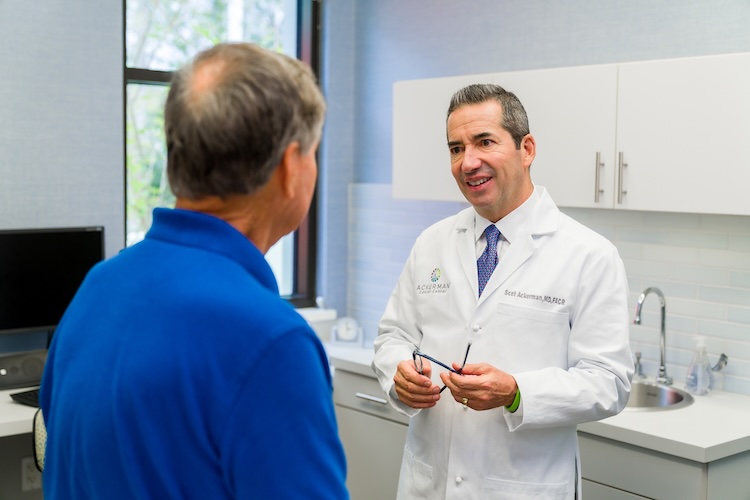
The best way to determine if LDRT is right for you is through a personalized consultation, where your care team can evaluate your symptoms, medical history, and treatment goals to recommend the most appropriate path forward. Physicians can also refer a patient for an LDRT evaluation.
Why Choose LDRT at our Center?
A Leading Practice
Expertise
Why We Stand Out
Advanced technology: State-of-the-art linear accelerators with precise imaging and treatment planning capabilities
Leading physicians: Board-certified radiation oncologists with decades of experience in precision radiation delivery
Personalized care plans: Every LDRT treatment plan is designed for your specific joint, symptoms, and goals
Specializes in treating a variety of conditions.

What to Expect During Treatment
- Consultation: You will meet with a board-certified radiation oncologist who will review your medical history, imaging (X-rays and/or MRI), and symptoms. Together, you will discuss whether LDRT is an appropriate option for your condition. This consultation will be billed through your insurance or can be paid OOP.
- Treatment planning: A CT simulation is performed to create a detailed image of your joint. Our dosimetry and physics teams use this to design a targeted treatment plan that delivers the correct dose precisely to the affected area while minimizing exposure to surrounding tissues.
- Treatment sessions: LDRT is delivered over six sessions, typically three times per week for approximately two weeks. Each session takes about 10 minutes. Treatment is completely painless you will lie comfortably on the treatment table while the machine delivers the radiation to your joint. Payment for LDRT treatment at Ackerman Cancer Center is $4,000, due prior to first treatment, following your consultation.
- Recovery timeline: There is no recovery period. You can drive yourself to and from treatments and resume normal activities immediately. Most patients begin to notice improvement within two to six weeks after completing the course. Full benefits may continue to develop over the following months. A second course of treatment can be considered for patients who do not respond adequately to the first.
Does Insurance Cover The Cost Of LDRT For Osteoarthritis?
Yes. LDRT for osteoarthritis is now covered by many insurance plans.
Our team will verify your benefits and help you understand any out-of-pocket costs before treatment begins.
Coverage varies by provider and individual plan. For patients without insurance coverage, a self-pay option is available for $4,000 per treatment site.
Contact us today to learn more about your coverage options and schedule a consultation.

Frequently Asked Questions About Radiation for Osteoarthritis
What is the best treatment for osteoarthritis?
The best treatment depends on your specific situation, including which joints are affected, how severe your symptoms are, what treatments you have already tried, and your overall health. For many patients, a combination of physical therapy, weight management, and medications provides adequate relief. For those who have exhausted conservative options but are not ready for surgery, LDRT offers an advanced, non-invasive alternative that targets inflammation directly. Our radiation oncologists can help you evaluate your options during a consultation.
What are the most effective osteoarthritis pain treatments?
The most effective approach typically combines multiple strategies: regular low-impact exercise and physical therapy to maintain joint strength and flexibility, anti-inflammatory medications (NSAIDs) for acute pain management, and targeted interventions like corticosteroid injections for flare-ups. For patients who have not responded adequately to these approaches, LDRT provides a different mechanism of action by reducing inflammation at the cellular level, and in a 2025 randomized trial, 70% of LDRT patients responded compared with 42% on placebo.
What are the newest treatments for osteoarthritis?
Low-Dose Radiation Therapy (LDRT) represents one of the most significant advances in non-surgical osteoarthritis treatment. While LDRT has been used for over a century in Europe (particularly Germany, where it is a standard treatment), it is now gaining adoption in the United States following the publication of the landmark LoRD-KNeA randomized controlled trial in 2025, which demonstrated statistically significant pain relief compared to placebo. Other emerging therapies include platelet-rich plasma (PRP) injections and regenerative medicine approaches, though these remain less well-studied.
To learn more visit Radiant Joint Alliance.
Is LDRT safe for osteoarthritis?
Yes. LDRT uses very low radiation doses, a total of just 3 Gy over six sessions, compared to the 40–80 Gy used in cancer treatment. At these doses, the radiation works through anti-inflammatory mechanisms rather than cell destruction. Side effects are minimal and most patients experience no side effects at all, while a small number may notice mild, temporary skin redness at the treatment site. The treatment does not affect your ability to undergo joint replacement surgery in the future if needed. LDRT has been endorsed by the German Society of Radiation Therapy and Oncology (DEGRO) and is supported by more than 25 published studies and a growing body of randomized controlled trial evidence.
How do I choose the right osteoarthritis treatment option?
Start by evaluating where you are in your treatment journey. If you have not yet tried physical therapy, weight management, or anti-inflammatory medications, those should typically be your first steps. If you have tried these approaches without adequate relief and are considering your next options, a consultation with a radiation oncologist at Ackerman Cancer Center can help determine whether LDRT is appropriate for your specific case. We will review your imaging, medical history, and treatment history before making a recommendation.
How long does LDRT osteoarthritis treatment take?
The complete course of LDRT consists of six treatment sessions delivered over approximately two weeks (three sessions per week). Each individual session takes about 10 minutes. There is no preparation, no anesthesia, and no recovery time, you can drive yourself and resume normal activities immediately after each session. Most patients begin to notice improvement within two to six weeks after completing treatment, with benefits continuing to develop over the following months.
Where can I get osteoarthritis treatment in Florida?
Ackerman Cancer Center offers LDRT for osteoarthritis at our Northeast Florida locations: Mandarin (Jacksonville) and Amelia Island. Our board-certified radiation oncologists have decades of experience delivering precise radiation therapy and will work with you to determine whether LDRT is the right option for your joint pain. Call (904) 880-5522 or schedule a consultation to learn more.
Feel Relief: Get Advanced Arthritis Treatment
You do not have to choose between living with chronic joint pain and undergoing major surgery. LDRT offers a proven, non-invasive alternative that has helped thousands of patients in Europe — and is now available right here in Northeast Florida.
Take the first step toward relief:
- Schedule a consultation with a board-certified radiation oncologist to discuss whether LDRT is right for you
- Speak with our team about your symptoms, treatment history, and goals
- Insurance verification is available for the initial consultation — call (904) 880-5522 to get started